


 Wings
 Racing Tribal
 Flames
 Barbecue BBQ
 Body Building
 Dive Scuba sports
 Fishing Lures
 Martial Arts
 Martial Hieroglyph
 Paintball
 Sailing
 Surf
 Farm Birds
 Farm Mammals
 Mammals
 Birds
 Insects
 Reptiles
 Snakes
 Fishes Fresh Water
 Fishes Salt Water
 Dolphins
 Tuna
 Sharks
 Dragons
 Monsters
 Zombies
 Alien UFO
Safety Guides
Forklift Safety Decals: Which Ones You Need and Where
Nov
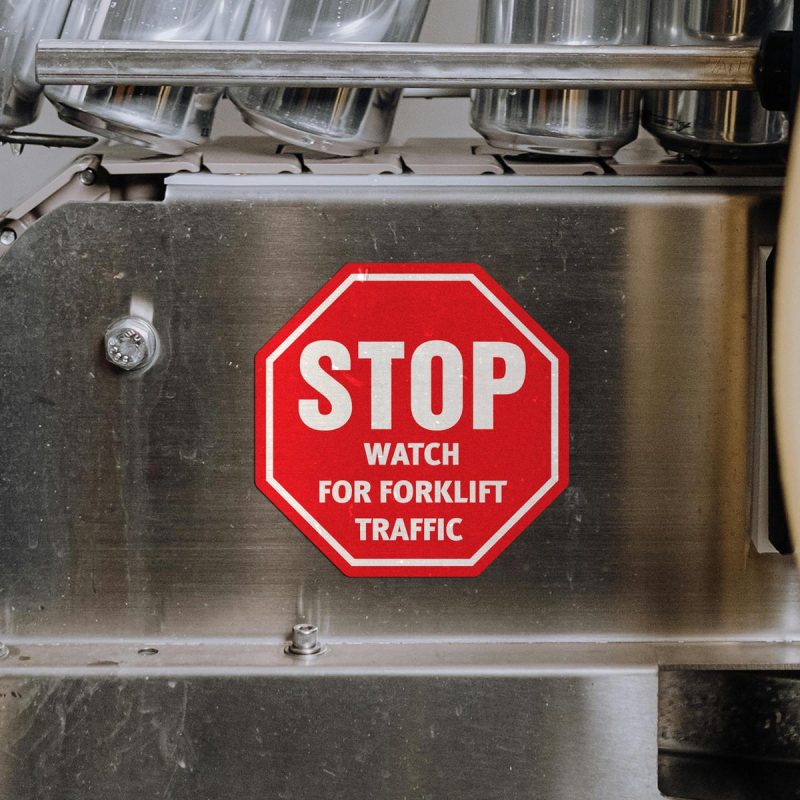
Quick answer: forklift safety decals do two jobs. On the truck they keep the manufacturer’s data plate and warning labels legible (OSHA 29 CFR 1910.178(a)(6)) and add site rules such as authorised operators only, daily inspection and seat belts. Around the truck they warn people where forklifts and pedestrians meet: STOP / sound horn at blind intersections, “watch for forklift traffic” at aisle entries, pedestrian crossings, doors that are not for pedestrians, and “no forklifts” zones.
Place each one where the decision is made, at the eye level of whoever has to act on it: the driver for horn and speed signs, the person on foot for crossing and door signs.
Most forklift accidents involving pedestrians happen at the same few places: an aisle end where a racking upright hides the cross traffic, a doorway between the loading bay and the warehouse, and the strip in front of the charging area where trucks are parked. A forklift safety decal is only useful if it sits in one of those places and says one clear thing. This guide goes zone by zone through which decals you need, which rules they connect to, and what we have learned producing them for warehouses and workshops.
What the rules actually say about forklift decals
In the US, the forklift standard is OSHA 29 CFR 1910.178. It does not give you a list of signs to buy, but several of its paragraphs are about markings:
- 1910.178(a)(6): the user must keep all nameplates and markings in place and legible. A faded or peeled warning label is a finding, not a cosmetic issue.
- 1910.178(a)(4): if a modification that affects capacity or safe operation is approved by the manufacturer, the capacity, operation and maintenance plates, tags or decals must be changed to match.
- 1910.178(a)(5): when a truck gets a front-end attachment that was not fitted at the factory, the user must ask for the truck to be marked to identify the attachment and show the approximate combined weight.
- 1910.178(n)(4): drivers must slow down and sound the horn at cross aisles and wherever vision is obstructed. That is why “STOP – sound horn” signs belong at blind intersections.
- 1910.176(a): permanent aisles and passageways must be appropriately marked, which is where floor tape and aisle signs come in.
OSHA’s powered industrial truck eTool adds that safety labels on the truck should be clearly visible to the operator and replaced if they are missing, damaged or illegible. In Europe the same messages are usually given with ISO 7010 pictograms: W014 (warning, forklift trucks) and P006 (no access for forklift trucks and other industrial vehicles). One honest limit: the manufacturer’s data plate itself is an OEM part. Replace it through the dealer, not with a generic sticker.
Where each forklift decal belongs
| Zone | Decal | Who reads it | Example |
|---|---|---|---|
| Blind aisle intersection | STOP – sound horn, proceed with caution | Driver, 5–10 m before the corner | STOP Sound Horn |
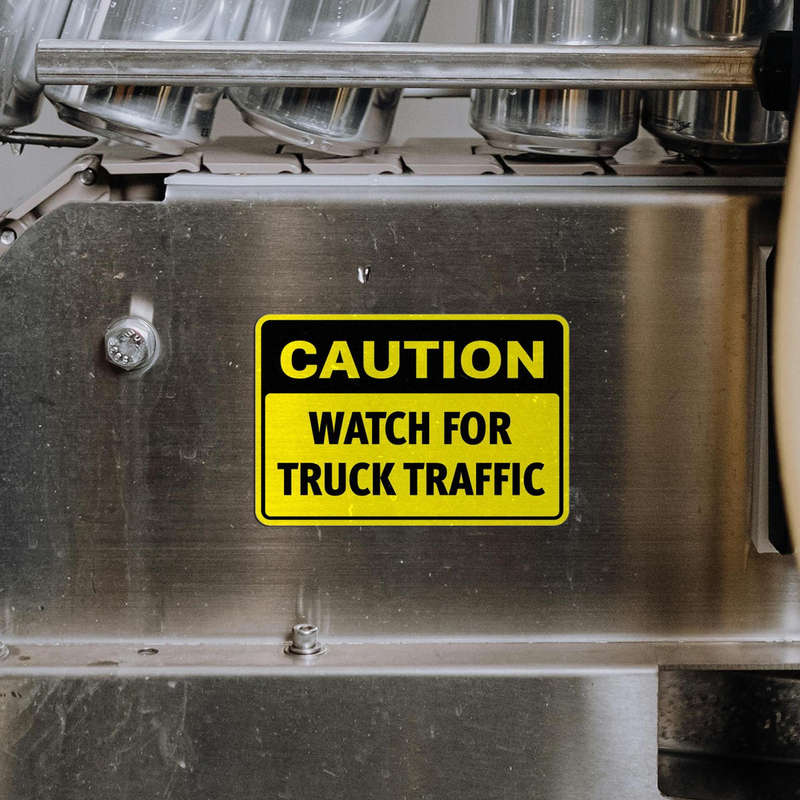
| Aisle entry, racking end | Caution / watch for forklift traffic | People on foot entering the aisle | Watch for Truck Traffic |
| Marked walkway crossing | Pedestrian crossing, slow down | Both: driver and pedestrian | Pedestrian Crossing |
| Vehicle-only doors | Not for pedestrian traffic / forklifts only | People on foot | Door Not for Pedestrians |
| Offices, canteen, fragile floors | No forklifts | Driver | No Forklifts Allowed |
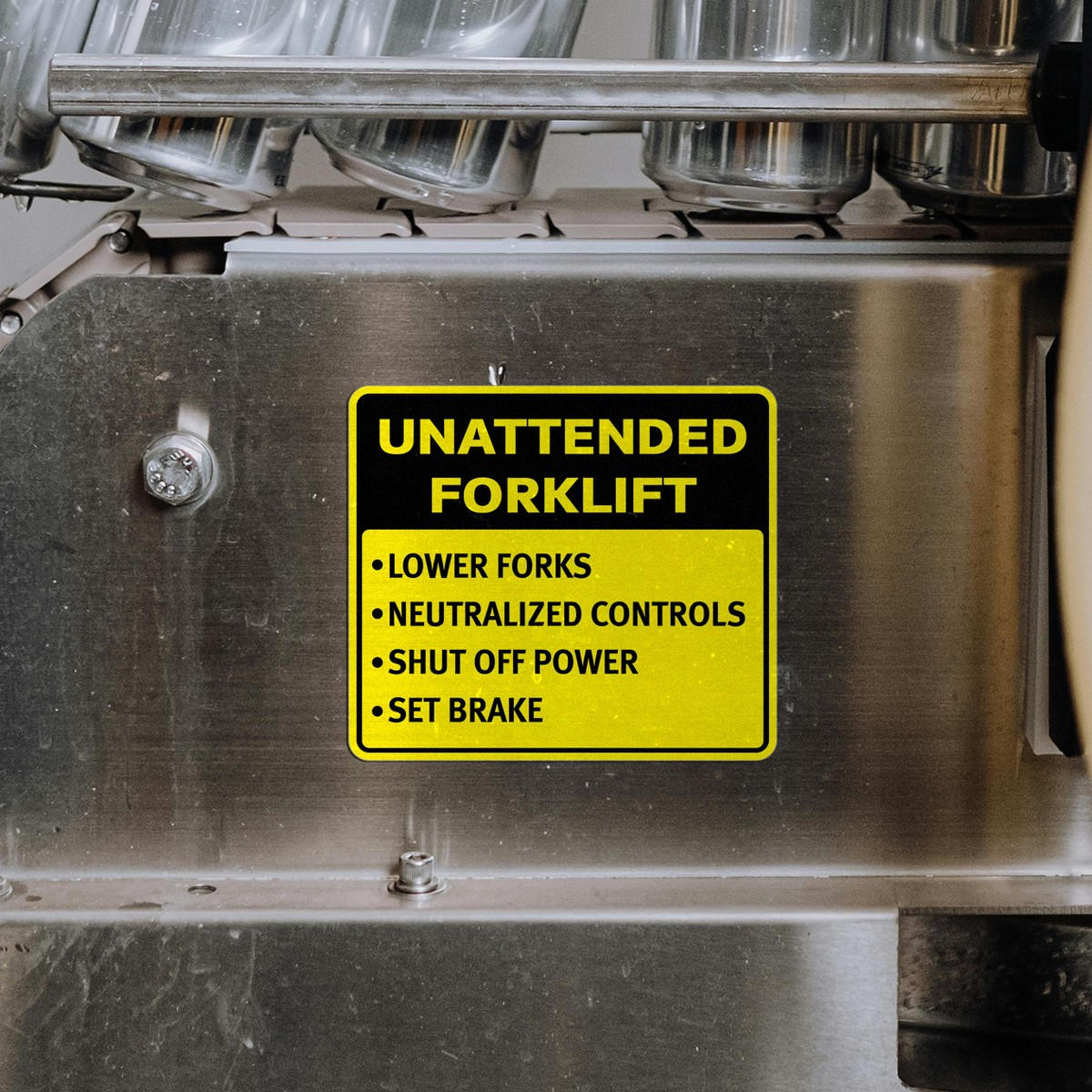
| Parking and charging area | Unattended forklift procedure, lower forks | Driver leaving the truck | Unattended Forklift |
| On the truck | Authorised operators, daily inspection, seat belt | Driver, before and during use | Daily Inspection |
Intersections and aisle ends
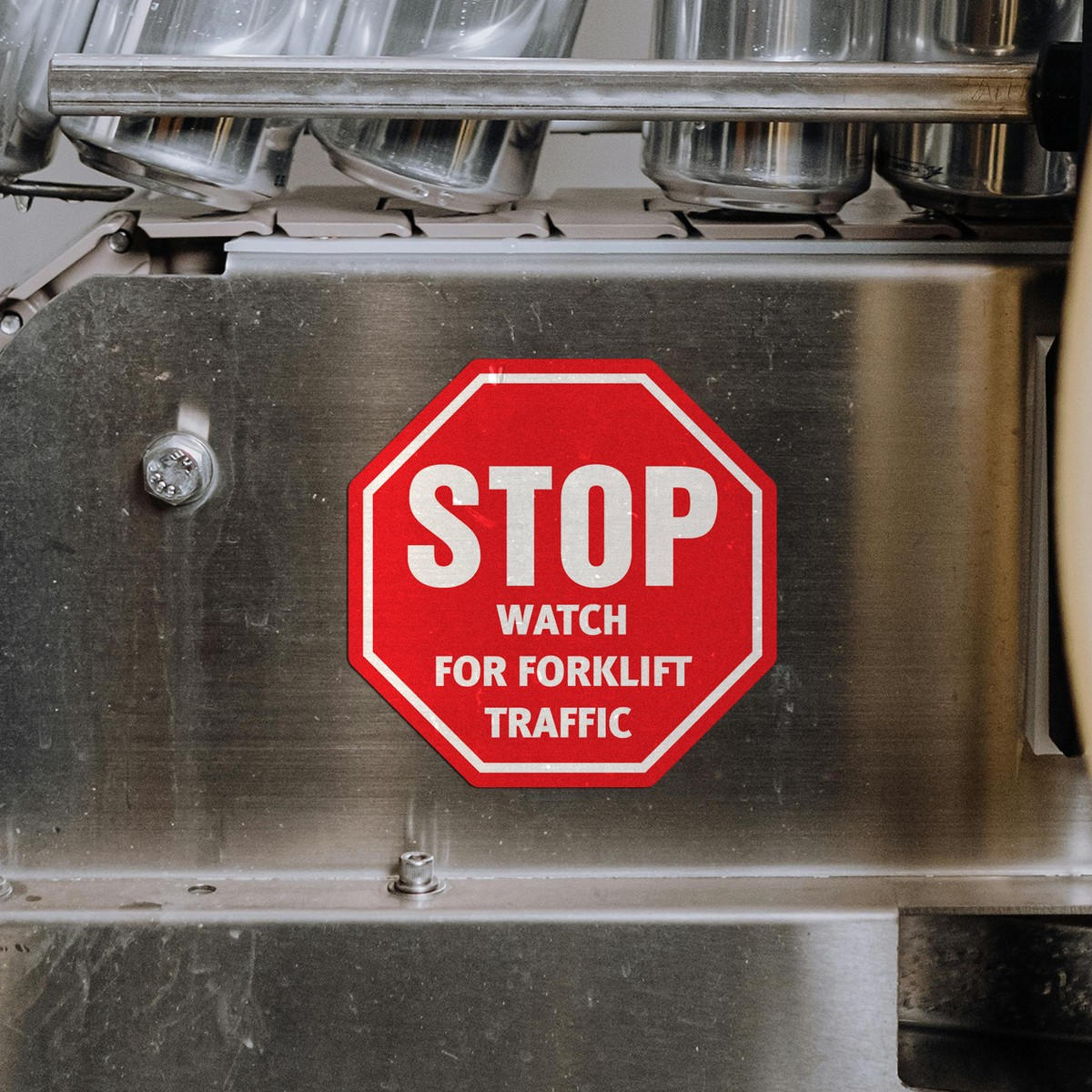
This is the highest-risk point in most warehouses. Put the STOP / sound horn sign on the driver’s side, facing the approaching truck, a few metres before the corner so there is time to brake. Facing the other way, on the racking end or the wall, a yellow “watch for forklift traffic” decal warns people who are about to step out. One sign for each direction of travel is better than one large sign that only half the traffic sees. Where drivers keep forgetting the speed limit, a Do Not Exceed Speed Limit decal at the same corner repeats it.

Doors and pedestrian routes
Roller doors used by forklifts should not double as walkways. Mark the vehicle door with Danger: Forklifts Only, No Pedestrian Traffic or This Door Is Not for Pedestrian Traffic and point people to the personnel door next to it. Put the decal at eye height for someone walking, on the door frame or wall beside it, not on the moving door panel where it disappears when the door is open. Where trucks are not allowed at all, such as offices, the canteen or a mezzanine with a floor load limit, a No Forklifts Allowed sign at the threshold does the job.
Parking, charging and shift change
Under 1910.178(m)(5)(i), an unattended truck must have the forks fully lowered, the controls neutralised, the power off and the brakes set, with wheels blocked on an incline. Paragraph (m)(5)(ii) defines unattended as the operator being 25 ft (about 7.6 m) or more away, or out of view. A checklist decal at the parking bay turns that rule into a habit at the exact moment the driver gets off.
Decals on the truck itself
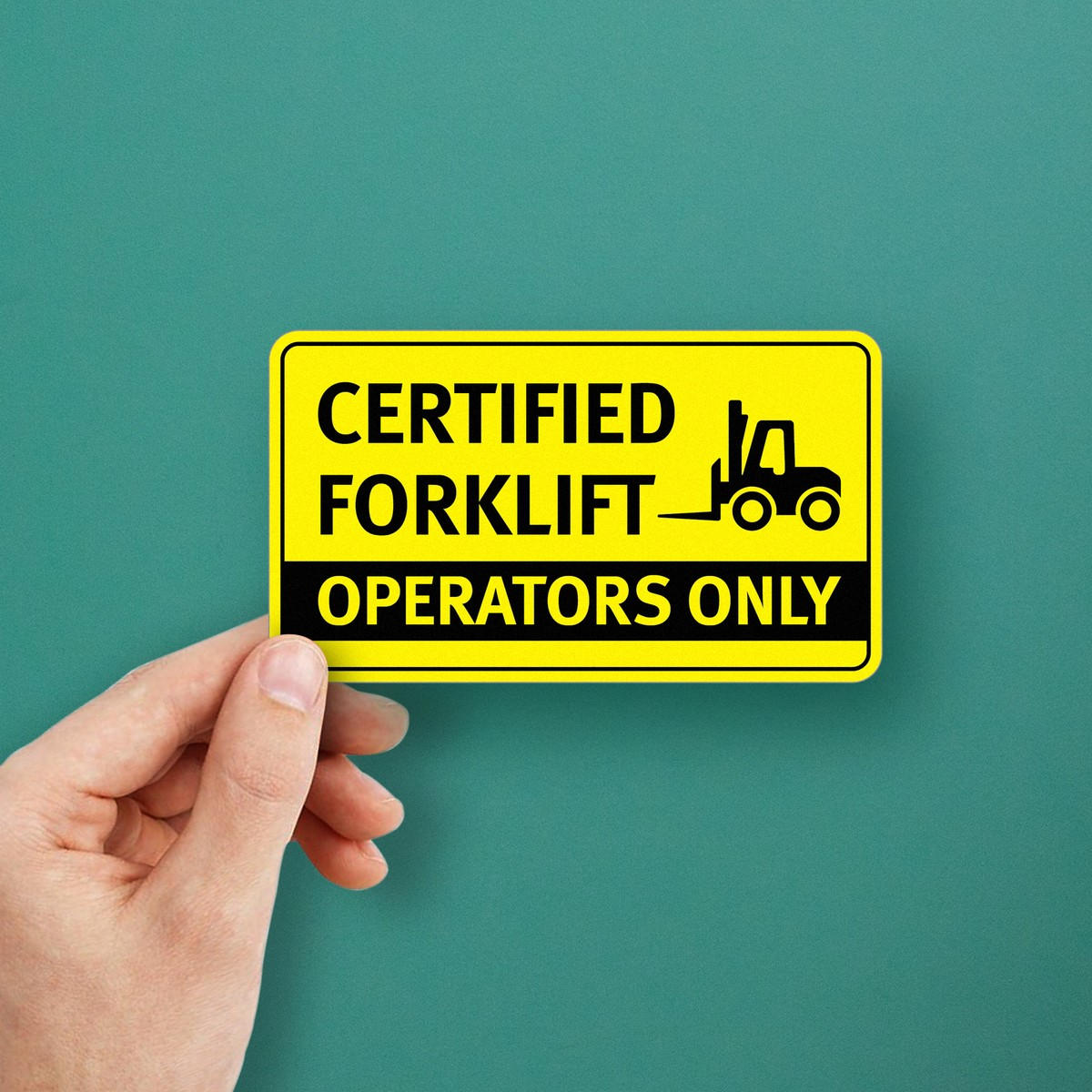
Keep the cab simple. The manufacturer’s capacity and warning labels come first and must stay readable. Then add only the site rules a driver needs in the seat: Certified Forklift Operators Only (1910.178(l) requires operators to be trained and evaluated), Forklift Daily Inspection (under (q)(7) trucks are examined before use, at least daily), and Fasten Seat Belts. A Lower Forks When Not in Use decal by the controls is a good extra. If the cab is crowded with decals, the important ones stop being read.

Danger, warning or caution: picking the signal word
OSHA’s eTool uses the same three levels for forklift labels. DANGER (red) means death or serious injury if the hazard is not avoided: use it for forklift-only doors and zones where people must never walk. WARNING (orange) means death or serious injury is possible. CAUTION (yellow) means minor or moderate injury is possible: aisle entries, crossings, speed reminders. Do not put DANGER everywhere. If every sign in the building is red, people stop reacting to the one that matters. Our guide to industrial safety stickers covers the colour system in more detail.
Size: can the driver read it in time?
A useful sign-industry rule of thumb is about 1 inch of letter height per 10 feet of viewing distance, roughly 0.8 cm per metre. A driver who has to read the main word of a STOP sign 8 metres before a corner needs letters of about 6–7 cm, so for an intersection choose A4 size or larger rather than a hand-sized decal. Decals on the truck, read from the seat at under a metre, can be small. Pictogram signs (the forklift symbol, the STOP octagon) are recognised from further away than words of the same size, so combine both. Our article on fonts readable from 20 metres explains the rule and how to test it.
Which material for forklift areas
| Where | Material | Rated outdoor life | Why |
|---|---|---|---|
| Truck body, outdoor yards, loading docks | Polymeric vinyl 70 µm + laminate | 6–9 years | Thin, conformable, holds on painted steel through sun and rain |
| Indoor walls, doors, racking ends | Monomeric vinyl 95 µm + laminate | 3–5 years | Stiffer, cost-effective for flat indoor surfaces |
| Single-colour lettering (speed limits, bay numbers) | Oracal 651 cut vinyl | Long-term | No background, clean look on doors and glass |
Every printed decal is laminated, which protects it against scratches, scuffs and cleaning. Near battery charging or refuelling points, wipe any spills off the decals promptly. If a label will be exposed to fuel, oil or chemicals all the time, tell us before ordering and we will advise on the material.
Forklift safety decals in the shop
 “Stop: Watch for Forklift Traffic” Safety Sign
 Forklift Warning Sticker – Bold Yellow
 Caution Forklift Traffic Sticker – High-Visibility Safety Decal
 Danger Forklifts Only No Pedestrian Traffic Sticker – Safety
 Caution Slow Down Pedestrian Traffic Sticker – High-Visibility
 “Unattended Forklift” Safety Sticker
 STOP Sound Horn Proceed With Caution Sign
 Certified Forklift Operators Only Sign
 Caution Pedestrian Crossing Sticker
 Forklift Daily Inspection Sticker Decal
 Load Capacity Sign Sticker
 Notice Authorized Drivers Only Sticker – Lift Truck Operation
See the full range of 38 designs in forklift safety stickers, plus machinery safety, door safety and anti-slip floor signs for the walkway itself.
From our production floor
- Forklift decals are printed with Epson eco-solvent ink for the truck body and outdoor areas, where the ink bites into the vinyl for strong adhesion, and with HP Latex for indoor signs, which come off the printer fully cured and odourless.
- Lamination is not optional here: it is what keeps a yellow caution decal readable after months of pallets brushing past it.
- Shaped signs, like the STOP octagon or a round forklift symbol, are contour-cut on our Zünd G3 table with camera registration, so the cut follows the printed edge exactly.
- On a truck, degrease the panel with isopropyl alcohol, apply at around 20 °C and squeegee from the centre out. Do not pressure-wash it for 48 hours.
Custom forklift signs for your site
Every design can be changed, and we also make signs from scratch: your site speed limit (“10 km/h”), bay and aisle numbers, the name of a charging area, or a sign in two languages for a mixed workforce. Any text, any size and any language, with a library of about 1,500 typefaces. There is no minimum order: one replacement decal or a set for the whole fleet. Orders ship from Greece with tracking, usually within 1–2 business days.
Not sure which size or film fits? Send us a photo of the wall, door or truck panel and the size you need, and we will recommend the right material. For fitting steps, read how to apply stickers.
FAQ
Does OSHA require forklift safety decals?
OSHA 1910.178 requires the nameplates and markings on the truck to stay in place and legible, decals to be updated after approved modifications, and attachments to be marked. It does not prescribe a set list of signs around the truck, but it does require drivers to slow down and sound the horn at cross aisles, and 1910.176(a) requires permanent aisles to be marked.
Where should a “sound horn” sign go?
Facing the driver, a few metres before a blind intersection, aisle end or doorway, so there is time to slow down. If traffic comes from two directions, use one sign for each.
Can I replace the forklift data plate with a sticker?
No. The capacity data plate is a manufacturer part with figures specific to that truck and its attachments. Order it from the dealer. Our decals are for the warnings and site rules around it.
Should forklift signs use DANGER or CAUTION?
DANGER for places where people must never be, such as forklift-only doors. CAUTION for places where the hazard is possible, such as aisle entries and walkway crossings. Using DANGER everywhere weakens it.
Can you make a forklift sign in another language?
Yes. We can make any design with your own text in any language, or in two languages on one sign, at any size, with no minimum order.
More safety ranges: Forklift safety · Equipment & machinery safety · Door safety · Anti-slip floor signs · All safety signs. Related reading: floor marking in warehouses and industrial safety stickers.
Browse forklift safety stickers
